
Straight Lines
Linear Equations in Two Variables
The equation y = 2x – 1
that we used as an example for graphing functions produced a graph that was a straight line. This was no accident. This equation is one example of a general class of equations that we call linear equations in two variables. The two variables are usually (but of course don’t have to be) x and y. The equations are called linear because their graphs are straight lines. Linear equations are easy to recognize because they obey the following rules:
- The variables (usually x and y) appear only to the first power
- The variables may be multiplied only by real number constants
- Any real number term may be added (or subtracted, of course)
- Nothing else is permitted!
- This means that any equation containing things like x2, y2,1/x, xy, square roots, or any other function of x or y
is not linear.
Describing Lines
Just as there are an infinite number of equations that satisfy the above conditions, there are also an infinite number of straight lines that we can draw on a graph. To describe a particular line we need to specify two distinct pieces of information concerning that line. A specific straight line can be determined by specifying two distinct points that the line passes through, or it can be determined by giving one point that it passes through and somehow describing how “tilted” the line is.
Slope
The slope of a line is a measure of how “tilted” the line is. Ahighway sign might say something like “6% grade ahead.” What does this mean, other than that you hope your brakes work? What it means is that the ratio of
your drop in altitude to your horizontal distance is 6%, or 6/100. In other words, if you move 100 feet forward, you will drop 6 feet; if you move 200 feet forward, you will drop 12 feet, and so on.
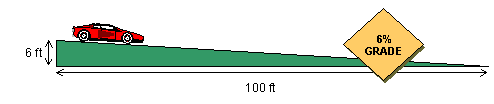
We measure the slope of lines in much the same way, although we do not convert the result to a percent.
Suppose we have a graph of an unknown straight line. Pick any two different on the line and label them point 1 and point 2:
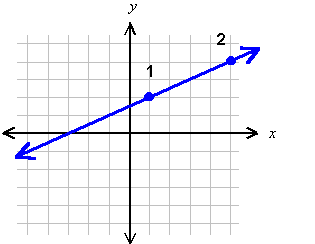
In moving from point 1 to point 2, we cover 4 steps horizontally (the x direction) and 2 steps vertically (the y direction):
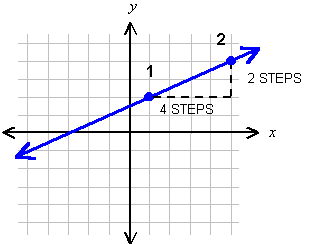
Therefore, the ratio of the change in altitude to the change in horizontal distance is 2 to 4. Expressing it as a fraction and reducing, we say that the slope of this line is

To formalize this procedure a bit, we need to think about the two points in terms of their x and y coordinates.
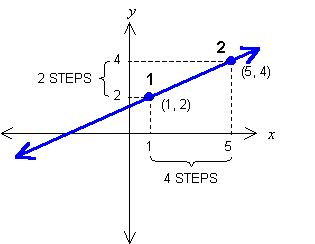
Now you should be able to see that the horizontal displacement is the difference between the x coordinates of the two points, or
4 = 5 – 1,
and the vertical displacement is the difference between the y coordinates, or
2 = 4 – 2.
In general, if we say that the coordinates of point 1 are (x1, y1) and the coordinates of point 2 are (x2, y2),
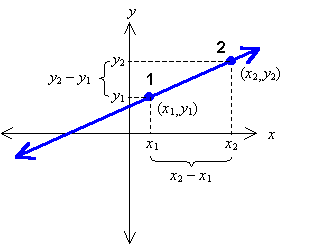
then we can define the slope m as follows:
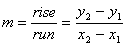
where (x1, y1) and (x2, y2) are any two distinct points on the line.
- It is customary (in the US) to use the letter m to represent slope. No one knows why.
- It makes no difference which two points are used for point 1 and point 2. If they were switched, both the numerator and the denominator of the fraction would be changed to the opposite sign, giving exactly the same result.
- Many people find it useful to remember this formula as “slope is rise over run.”
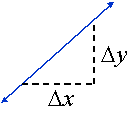
- Another common notation is
 , where the Greek letter delta (D) means “the change in.” The slope is a ratio of how much y changes per change in x:
Horizontal Lines
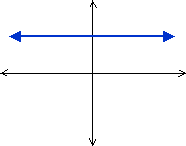
A horizontal line has zero slope, because there is no change in y as x increases. Thus, any two points will have the same y coordinates, and since y1 = y2,
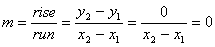 .
.
Vertical Lines
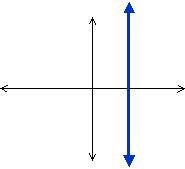
A vertical line presents a different problem. If you look at the formula
 ,
,
you see that there is a problem with the denominator. It is not possible to get two different values for xl and x2, because if x changes then you are not on the vertical line anymore. Any two points on a vertical line will have the same x coordinates, and so x2 – x1 = 0. Since the denominator of a fraction cannot be zero, we have to say that avertical line has undefined slope. Do not confuse this with the case of the horizontal line, which has a well-defined slope that just happens to equal zero.
Positive and Negative Slope
The x coordinate increases to the right, so moving from left to right is motion in the positive x direction. Suppose that you are going uphill as you move in the positive x direction. Then both your x and y coordinates are increasing, so the ratio of rise over run will be positive—you will have a positive increase in y for a positive increase in x. On the other hand, if you are going downhill as you move from left to right, then the ratio of rise over run will be negative because you lose height for a given positive increase in x. The thing to remember is:
As you go from left to right,
- Uphill = Positive Slope
- Downhill = Negative Slope
And of course, no change in height means that the line has zero slope.
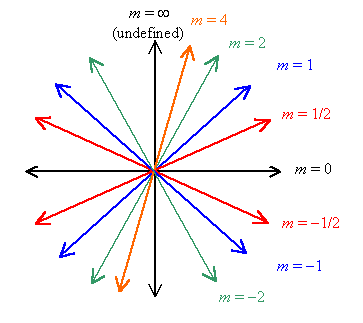
Some Slopes
Intercepts
Two lines can have the same slope and be in different places on the graph. This means that in addition to describing the slope of a line we need some way to specify exactly where the line is on the graph. This can be accomplished by specifying one particular point that the line passes through. Although any point will do, it is conventional to specify the point where the line crosses the y-axis. This point is called the y-intercept, and is usually denoted by the letter b. Note that every line except vertical lines will cross the y-axis at some point, and we have to handle vertical lines as a special case anyway because we cannot define a slope for them.
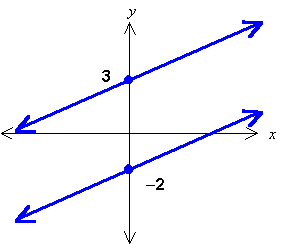
Same Slopes, Different y-Intercepts
Equations
The equation of a line gives the mathematical relationship between the x and y coordinates of any point on the line.
Let’s return to the example we used in graphing functions. The equation
y = 2x – 1
produces the following graph:
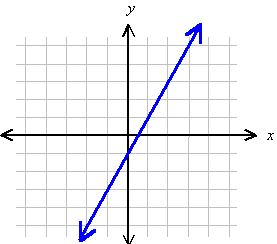
This line evidently has a slope of 2 and a y intercept equal to –1. The numbers 2 and –1 also appear in the equation—the coefficient of x is 2, and the additive constant is –1. This is not a coincidence, but is due to the standard form in which the equation was written.
Standard Form (Slope-Intercept Form)
If a linear equation in two unknowns is written in the form
|
y = mx + b |
where m and b are any two real numbers, then the graph will be a straight line with a slope of m and a y intercept equal to b.
Point-Slope Form
As mentioned earlier, a line is fully described by giving its slope and one distinct point that the line passes through. While this point is customarily the y intercept, it does not need to be. If you want to describe a line with a given slope m that passes through a given point (x1, y1), the formula is
|
|

To help remember this formula, think of solving it for m:

Since the point (x, y) is an arbitrary point on the line and the point (x1, y1) is another point on the line, this is nothing more than the definition of slope for that line.
Two-Point Form
Another way to completely specify a line is to give two different points that the line passes through. If you are given that the line passes through the points (x1, y1) and (x2, y2), the formula is
|
|
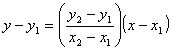
This formula is also easy to remember if you notice that it is just the same as the point-slope form with the slope m replaced by the definition of slope,
