
The Quadratic Formula
The solutions to a quadratic equation can be found directly from the quadratic formula.
|
The equation ax2 + bx + has solutions
|
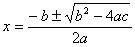
The advantage of using the formula is that it always works. The disadvantage is that it can be more time-consuming than some of the methods previously discussed. As a general rule you should look at a quadratic and see if it can be solved by taking square roots; if not, then if it can be easily factored; and finally use the quadratic formula if there is no easier way.
· Notice the plus-or-minus symbol (±) in the formula. This is how you get the two different solutions—one using the plus sign, and one with the minus.
· Make sure the equation is written in standard form before reading off a, b, and c.
· Most importantly, make sure the quadratic expression is equal to zero.
The Discriminant
The formula requires you to take the square root of the expression b2 – 4ac, which is called the discriminant because it determines the nature of the solutions. For example, you can’t take the square root of a negative number, so if the discriminant is negative then there are no solutions.
| If b2 – 4ac > 0 | There are two distinct real roots |
| If b2 – 4ac = 0 | There is one real root |
| If b2 – 4ac < 0 | There are no real roots |
Deriving the Quadratic Formula
The quadratic formula can be derived by using the technique of completing the square on the general quadratic formula:
|
Given: |
 |
|
Divide through by a: |
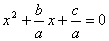 |
|
Move the constant term to the right |
 |
|
Add the square of one-half the |
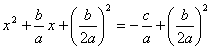 |
|
Factor the left side (which is now a |
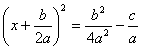 |
|
Get the right side over a common |
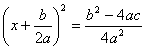 |
|
Take the square root of both sides |
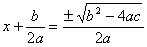 |
|
Solve for x: |
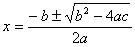 |